Virtual reality team building activities that work
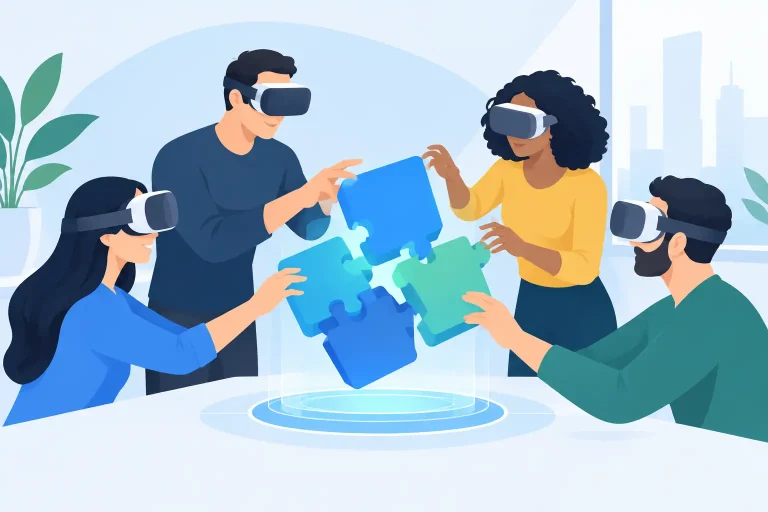
Most teams do not need another afternoon of polite small talk, competitive bowling or a puzzle completed by the loudest people in the room. They need a shared experience that makes everyday working habits visible without putting anyone on the defensive. Done well, virtual reality team building activities create exactly that: a high-energy challenge where communication, decision-making and behavioural adaptability have real consequences.
The headset is not the development intervention on its own. The value comes from what happens around the experience: understanding how people prefer to work, watching those preferences play out under pressure, then turning the observations into better choices back at work. Virtual Reality. Real team growth.
Why virtual reality team building activities reveal more
In a well-designed VR escape-room challenge, teams must solve problems with incomplete information, limited time and changing demands. One person may spot a detail others have missed. Another may instinctively take charge. Someone else may pause to check that everyone understands the plan. None of these responses is inherently right or wrong, but each affects how the team performs.
That is why the format is more revealing than a passive away day. People cannot simply agree with a presentation about collaboration. They have to collaborate. The environment creates enough urgency for natural habits to appear, while remaining separate from the pressures of a live project, customer deadline or performance review.
For leaders, this can surface useful questions. Does the team make space for quieter expertise? Do people clarify roles before acting? What happens when a confident idea is wrong? How quickly do colleagues recover from disagreement? A facilitator can help participants explore these patterns as shared working dynamics rather than personal shortcomings.
The difference between VR entertainment and team development
A virtual reality activity can be memorable and still have little effect on how a team works on Monday morning. The distinction lies in the learning design.
Entertainment-led sessions tend to measure success by laughter, scores and whether everyone had a good time. Those things matter. A positive shared experience can strengthen connection and willingness to participate. But if the activity ends when the headsets come off, its impact is likely to be short-lived.
Development-led sessions connect challenge to insight and action. Participants first build a practical understanding of their own behavioural preferences and the preferences around them. They then enter a competitive, immersive environment where those differences become tangible. Afterwards, structured reflection turns moments from the game into language the team can use at work.
For example, a team may realise that its fast starters are valuable when momentum is needed, but can unintentionally move ahead before colleagues have shared critical information. Rather than labelling that behaviour as a problem, the group can agree when speed helps, when a pause is needed and how to signal either requirement clearly.
What an effective experience should include
The strongest programmes follow a deliberate progression from insight to application. A VR challenge should never feel bolted on to a generic workshop.
1. A clear view of working preferences
Behavioural preference modelling gives participants a non-judgemental way to discuss how they communicate, decide, organise and respond to change. It helps teams replace assumptions such as “they are difficult” or “they never listen” with more useful observations: “they need time to process” or “they are focused on getting moving quickly”.
This shared vocabulary is particularly valuable for cross-functional teams. Different priorities often reflect the demands of different roles, not a lack of commitment. When people understand this, they can adapt their approach without losing their own strengths.
2. A challenge that requires genuine interdependence
The VR task needs more than visual spectacle. It should require participants to exchange information, co-ordinate actions, manage uncertainty and make decisions together. If one highly capable player can complete everything alone, the activity is a game for individuals, not a development experience for a team.
Escape-room scenarios work well because progress depends on collective attention. A clue seen by one person may only make sense when combined with something noticed by another. Time pressure adds energy, but it should not become so intense that reflection gives way to pure panic.
3. Skilled facilitation after the action
The debrief is where an enjoyable activity becomes a performance-improvement intervention. A skilled facilitator does not tell people what they should have done. They draw out specific evidence from the experience and invite the team to make sense of it together.
Useful reflection is precise. Instead of asking, “How was that?”, ask, “At what point did the team lose clarity?”, “Whose contribution changed the direction of the task?” or “What did you do when two approaches competed?” The answers give the group a credible starting point for discussing communication, conflict resolution and productivity.
4. A small number of commitments that can be practised
Teams do not need a wall of vague promises. They need two or three observable habits they can use in meetings, handovers and problem-solving conversations. This might mean naming a decision owner at the start of a task, inviting alternative views before committing, or agreeing how to raise concerns when the pace feels too fast.
The best commitments are owned by the team and revisited by the team. Managers can support this by asking about progress in regular catch-ups, rather than treating the event as a standalone reward.
When VR is especially useful
Virtual reality is a strong fit when a team needs to reset patterns without reopening every historic frustration in the room. A shared challenge gives people something immediate and neutral to discuss. It can be particularly helpful after a restructure, during the formation of a new leadership team, or when departments need to collaborate more closely.
It also works well for capable teams that are not in crisis. High-performing groups can use the experience to test how they handle pressure, disagreement and shifting priorities before those conditions arrive on an important project.
Teams Glued uses this combination of behavioural insight, immersive escape-room challenge and facilitated action planning to help organisations move beyond the usual away-day conversation. The aim is not to manufacture conflict or force a particular personality style. It is to help colleagues recognise the value each person brings and adapt more deliberately when the situation demands it.
Design for inclusion, not just excitement
Not every employee will approach VR with the same confidence or comfort. Some may have concerns about motion sensitivity, sensory load, accessibility, previous gaming experience or simply being observed while trying something unfamiliar. Treating these concerns seriously is part of creating psychological safety.
A well-run session explains what to expect, gives clear guidance before headsets are used and allows people to participate without embarrassment. The technology should support the learning, not become a test of technical confidence. Facilitators should also make sure that the discussion includes people who contributed through planning, observation and communication, not only those who appeared most active in the virtual environment.
There is a trade-off here. More competition can increase excitement, but too much can encourage teams to chase a score at the expense of the behaviours they are there to examine. The right balance depends on the group, its existing relationships and the development outcome. For a team dealing with friction, co-operation and reflection may matter more than a dramatic leaderboard.
How to judge whether it made a difference
A strong reaction on the day is encouraging, but it is not the whole measure of success. Before booking, decide what better team performance would look like in practical terms. Perhaps meetings need clearer decisions, project handovers need fewer misunderstandings, or colleagues need a more constructive way to challenge one another.
Ask participants to identify the behaviours they will practise, then gather feedback after they have had time to apply them. Team leaders can look for evidence in everyday work: fewer duplicated tasks, more balanced participation in meetings, quicker escalation of risks or better quality decisions. The measures do not need to be complicated, but they should connect the experience to a real business need.
Escape the ordinary with purpose
The most valuable team activity is not the one people talk about only because it was unusual. It is the one that gives them a better way to work together when the next deadline, disagreement or complex decision arrives. Choose a VR experience that creates energy, makes behavioural differences useful and leaves the team with actions worth practising.