Why mid-level managers struggle under pressure, and what actually helps them improve
In most large UK organisations, the transition into management is still treated as a logical next step. High performers are promoted, given a short burst of training, and expected to lead.
And yet, this is where performance often dips.
Not because capability is absent, but because the context changes. The environment becomes more complex, more ambiguous, and significantly more pressured. What looked like competence in a previous role can quickly unravel.
For People Directors and L&D leaders, this creates a familiar problem. Investment in management development does not reliably translate into changed behaviour when it matters most.
The issue: the “competence cliff” in early leadership

New and mid-level managers experience a sharp shift in expectations. They move from doing the work themselves to enabling others to deliver it. Certainty gives way to ambiguity, and a focus on tasks evolves into a need to manage people, relationships and performance. Individual contribution is no longer the measure of success; collective outcomes are.
The capabilities required are not entirely new. Communication, judgement, listening and prioritisation still matter. What changes is the context in which they must be applied, which is often fast-moving, uncertain and under pressure.
That pressure is where the gap appears.
Most leadership programmes develop awareness and understanding. Real organisational life demands something more: the ability to make effective behavioural choices in the moment, when stakes and pressure are high.
Why traditional manager training doesn’t transfer
Even well-designed development programmes often struggle to create lasting behavioural change. Insight gained in a classroom setting fades quickly when it is not applied. People return to busy roles and revert to established habits.
Pressure intensifies this effect. Under strain, individuals default to what feels familiar, whether that is interrupting rather than listening, directing rather than involving others, or avoiding difficult conversations altogether. These responses are human and predictable, yet they are rarely addressed directly in training design.
Opportunities to practise are often limited or insufficiently realistic. Discussion and role play have value, but they cannot easily reproduce time pressure, interdependence, uncertainty or the emotional stakes that shape real workplace behaviour. Without those conditions, behaviour is not meaningfully tested.
Feedback is another limiting factor. While tools such as 360-degree reviews and workshop reflections provide useful perspectives, they are often removed from the moment itself. Participants understand what they might need to do differently, but they may not fully experience why that change matters in practice.
The operational cost of this gap
For larger organisations, this is not simply a development concern; it is a performance issue.
When managers struggle to operate effectively under pressure, the impact tends to surface in familiar ways. Decision-making slows down or becomes inconsistent, leading to rework. Conflict remains unresolved and begins to affect wider team dynamics.
Communication breaks down across functions, and senior leaders are drawn into issues that should be handled at lower levels. Over time, engagement and clarity within teams begin to diminish.
Individually, these issues are manageable. At scale, they create organisational friction, and friction carries a cost in time, energy and focus.
What actually helps: behaviour practice under realistic pressure

If behaviour breaks down under pressure, then development needs to reflect those conditions.
More effective approaches allow managers to experience pressure in a controlled way, act within it, receive immediate feedback, reflect on their choices, adjust, and then try again.
This cycle turns learning into something active rather than theoretical.
It is less about teaching leadership in the abstract and more about creating repeated opportunities to practise it in context. A useful analogy is that of a leadership gym rather than a classroom. The emphasis shifts from knowing to doing, and from understanding to application.
What simulation reveals that workshops don’t
Simulation-based environments offer something that more traditional formats struggle to replicate: visibility.
When managers are placed in a realistic, time-bound and interdependent scenario, their behaviour becomes easier to observe. Communication patterns emerge, decision-making approaches become clearer, and responses to pressure can be seen directly. Team dynamics, including moments of alignment and friction, unfold naturally.
Because this is experienced rather than described, it creates a stronger basis for reflection. Participants can connect what they did with what happened, which makes insight more immediate and more relevant.
Where Teams Glued fits
This is where Teams Glued has been designed to contribute. It is not positioned as a replacement for existing leadership frameworks or profiling tools, but as a way of making behaviour visible and debatable under pressure.
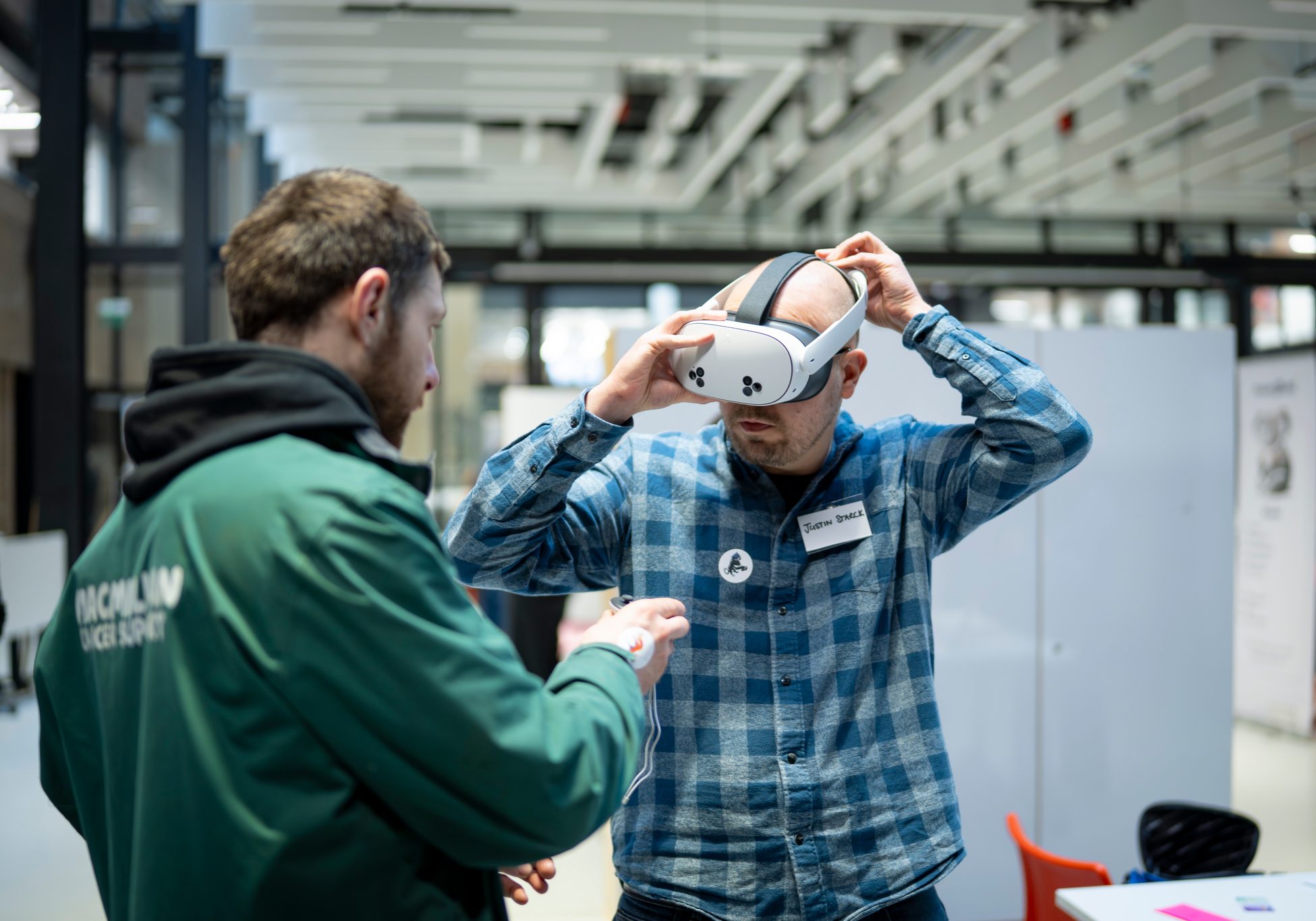
Participants work in small groups within a timed VR-based challenge that requires coordination, communication, problem-solving and shared decision-making. The role of the technology is simply to create an environment in which pressure feels real enough to prompt genuine responses.
Around that experience, the programme introduces structure and support. Participants take on defined roles that reflect workplace dynamics, and facilitators guide reflection to help link behaviours with outcomes.
Observation, both self-directed and external, helps participants recognise how they contribute to team effectiveness. Follow-up activity encourages reflection on what has changed back in the workplace over time.
The behaviours that surface — and shift
In these conditions, certain behaviours consistently come into focus. The clarity with which someone communicates expectations becomes immediately relevant to team progress. The quality of listening directly affects how well information is used. The ability to remain calm influences decision-making under time pressure, and the capacity to repair after moments of friction determines how quickly a team can recover and move forward.
These are not new ideas, but experiencing their impact in real time makes them tangible. Participants see the consequences of their behaviour as they happen, which creates a stronger incentive and ability to adjust.
Benefits when the issue is addressed
When managers become more aware of how they behave under pressure and begin to make more deliberate choices, organisations tend to see measurable shifts. Decisions become clearer and more timely. Misunderstandings reduce, which in turn lowers the need for rework. Conversations become more direct and constructive, and collaboration across teams becomes easier to sustain.
These are not framed as guaranteed outcomes, but as capabilities that develop over time when behaviour is practised and reflected upon in meaningful ways.
A practical way to scale in larger organisations
For organisations with more than 250 employees, this kind of development can be delivered in a structured and scalable way. Managers can progress through the experience in cohorts, creating a shared reference point and language.
Working in small pods ensures active participation and visibility of behaviour. The approach can be aligned with existing leadership frameworks, allowing it to complement rather than compete with current initiatives.
Follow-up reflection is an important element, helping to reinforce learning and connect it back to day-to-day work. This shifts the experience from a single event to part of an ongoing development process.
A more honest view of leadership development
There is no shortage of leadership theory available to managers. Most understand what good leadership looks like in principle.
The more difficult challenge is choosing those behaviours when the pressure is on.
That is where development efforts are often least effective, and where a more experiential, reflective approach can add value. Teams Glued sits within that space, helping teams to notice behaviour as it happens, reflect on it meaningfully, and explore different choices in a setting that feels real enough to matter.