VR escape room corporate Event that builds teams
We’ve all seen it: a corporate team-building event that fills an afternoon, produces a few fun photos for the company chat, and then… business returns to normal on Monday morning. But when you put a team under timed, unfamiliar pressure, everyday habits surface fast. You immediately see who takes control, who quietly waits to be asked, who shares information freely, and who gets frustrated when the obvious path blocks up.
That is where the real value lives. Immersive technology creates an engaging challenge, but the true opportunity is helping people notice how they work together, understand the impact of their personal styles, and practise more effective habits in real time. Virtual reality provides the spark; real team growth is the result.
What makes a VR escape room corporate event different?
A conventional escape room can be entertaining and memorable, but it often leaves teams with little more than a high score and a story about the one clue everyone missed. For organisations investing in employee development and culture, that isn’t enough.
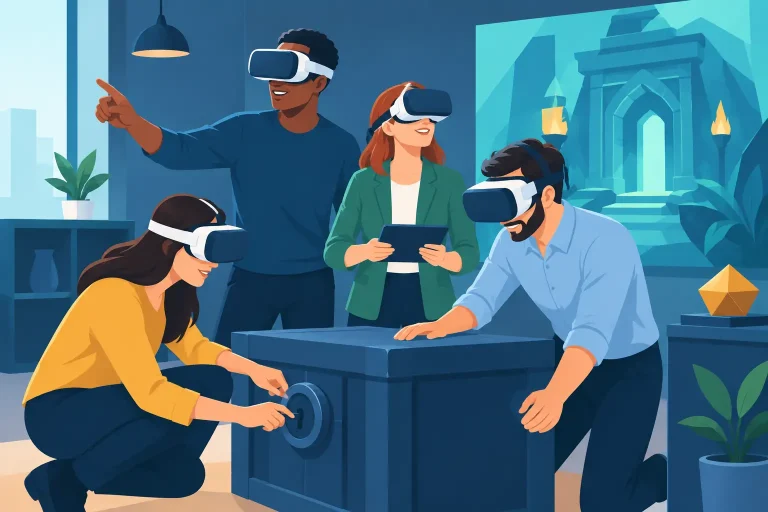
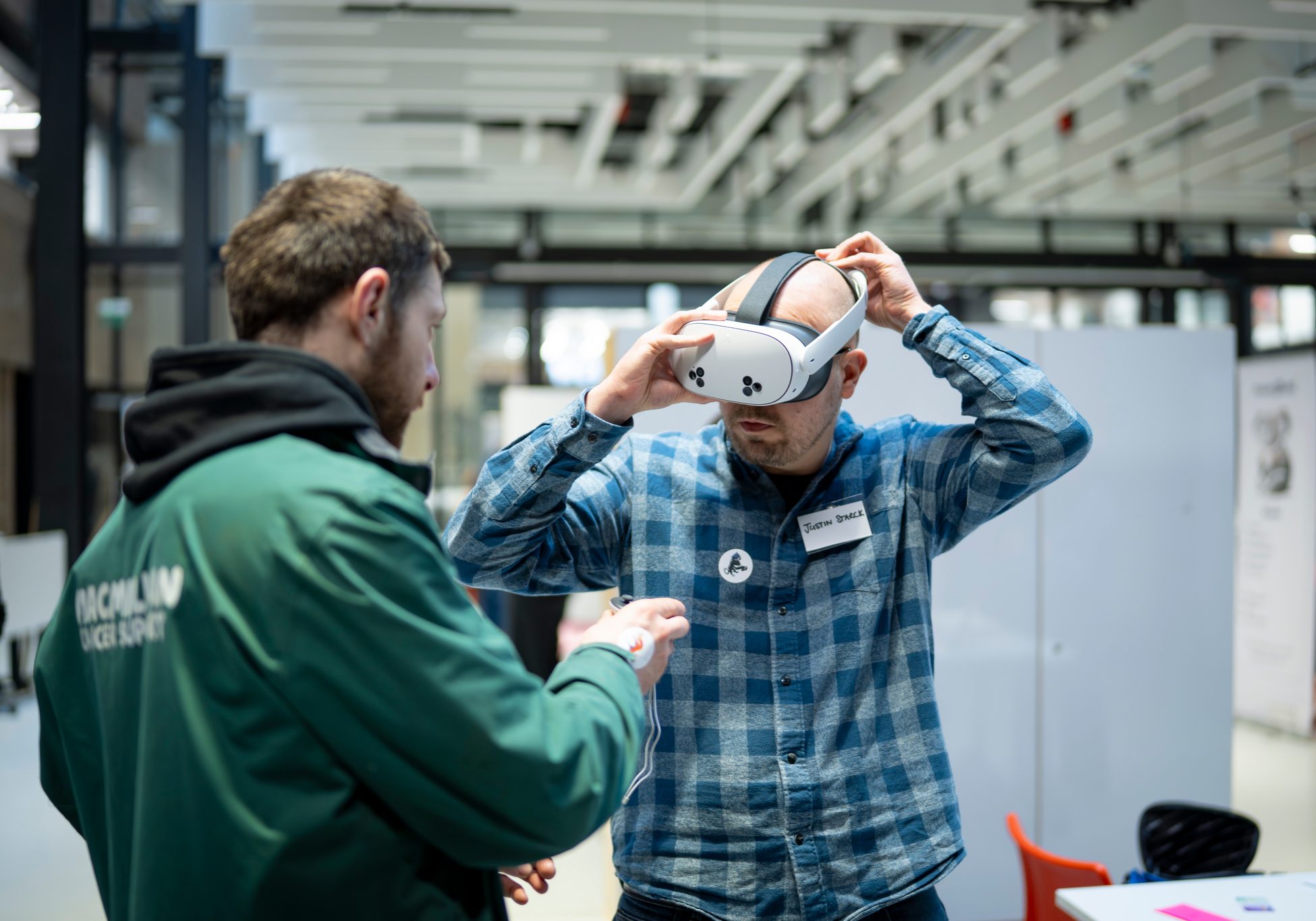
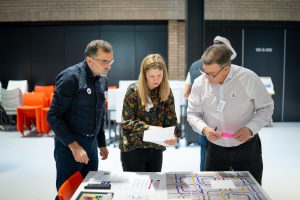
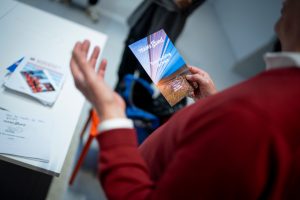
The most effective approach with Teams Glued isn’t an isolated headset experience where people disappear into their own worlds. Instead, one participant enters the virtual environment while their colleagues stay in the room, working with physical clues, blueprints, and data that directly support the player inside VR. Nobody can solve the challenge alone. The person in the headset sees one part of the puzzle; the team outside holds the rest.
This deliberate setup disrupts normal workplace habits. Colleagues have to describe what they see in plain language, listen closely, check for understanding, and coordinate decisions under time pressure. A technically confident colleague might need to slow down and explain a complex visual. A quieter team member might hold the exact piece of data needed to break a deadlock. A natural driver might have to pause and ensure everyone is aligned before pressing ahead.
It offers a low-risk, mirror-like view of real team dynamics. Because the scenario feels far removed from a weekly project meeting or a customer crisis, people can discuss behaviours openly without feeling defensive. Yet, the underlying communication habits on display are identical to those used in the office every day.
Why gameplay alone does not create better teamwork
New technology naturally pulls focus. It gives people something fresh to talk about and brings genuine energy into the room. But novelty alone doesn’t deliver lasting behavioural change.
Without structured preparation and debriefing, an immersive challenge can easily reward the loudest voice, the quickest guess, or the most aggressive approach. Those traits might help a team finish a game, but they don’t automatically build trust, psychological safety, or constructive problem-solving at work. In fact, unguided games can sometimes reinforce the very habits a team needs to unlearn.
A development-led session starts well before anyone puts on a headset. Participants explore their own behavioural tendencies—whether you frame these through DISC, Insights Discovery, or behavioural personality modelling using relatable profiles like the direct Panther, analytical Fox, enthusiastic Meerkat, or supportive Koala. These frameworks aren’t labels to hide behind; they are practical tools that help people anticipate friction and adjust their style when pressure mounts.
During the experience, the team applies these insights immediately. Afterwards, expert facilitation turns the activity into an honest, constructive conversation. What helped the group move forward? Where did communication break down? Who was included in decisions, and who was left out? What will we do differently in our next high-stakes project meeting?
To see how this combination of game-based tension and guided reflection translates into lasting workplace results, explore our case studies of real team impact.
The behaviours the challenge brings into view
A shared puzzle environment turns abstract ideas about workplace culture into visible habits. Teams quickly realize where they rely on assumptions, use vague directions, or become so focused on their own tasks that they miss what a colleague needs.
- Communication: The player in VR must describe space, shapes, and sequences clearly, while the team outside translates that information into action. Vague phrases like “try the button on the left” fall flat. High-performing teams establish a clear shared language, check understanding, and keep updates concise.
- Collaboration: Information is distributed across the room. This makes the power of active listening obvious and highlights whether the group draws on everyone’s strengths or defaults to the loudest voices.
- Constructive Conflict: Differing ideas are natural under pressure. The key is whether a team can disagree constructively, test an approach, and adapt without taking things personally or letting progress stall.
- Focus and Pace: Unstructured debate wastes precious minutes under a deadline. Teams learn the practical value of agreeing on a quick process, assigning roles, and pausing long enough to ensure they are solving the right problem.
Whether applied in corporate leadership programmes or used in further and higher education to prepare students for collaborative careers, these lessons give people a practical foundation for working effectively with others.
Designing the event around your team’s needs
A VR escape room experience works best when built around a clear organizational purpose. A newly formed leadership group might need to establish trust and clarify decision-making. A cross-functional unit might need to break down silos and streamline handovers. An established team might simply need a fresh, engaging way to sharpen their daily communication.
Session design should reflect those priorities. Grouping people with contrasting behavioural styles can reveal how different perspectives complement one another, while mixing functions or departments highlights how information flows through the organisation.
Timing is equally important. Packing an experience into the end of an exhausting conference day limits the depth of reflection. Allocating deliberate time for briefing, the challenge, and a structured debrief sends a clear signal that team growth is the priority, not just an afterthought.
At Teams Glued, VR serves as the catalyst rather than the whole story. The blend of hands-on problem solving, behavioural self-awareness, and guided debriefing leaves teams with something far more valuable than a win: a shared language for working better together.
How to turn insight into action after the event
A debrief should always conclude with clear, observable commitments rather than generic promises to “communicate better.” Teams need to pinpoint one or two specific actions that will make a measurable difference in their daily routine.
For one team, that might mean defining the desired outcome at the start of every meeting and checking that all perspectives have been heard before committing to a plan. For another, it might mean clarifying clear ownership points during project handovers or asking a colleague with an analytical style to review plans for potential blind spots before launching.
The most effective commitments are easy to observe. If a team can’t easily tell whether a habit is being practised, it’s hard to improve. Leaders can sustain momentum by checking in on these commitments during regular catch-ups, celebrating progress, and addressing friction early. This keeps the experience tied directly to daily work long after the event ends.
Questions to ask before booking
Before choosing a provider, ask whether the experience is engineered for pure entertainment, genuine team development, or a balance of both. Find out how behavioural frameworks are introduced, who leads the debrief, and what practical tools participants take back to their desks. Ensure every person has an active, meaningful role throughout the session, whether they are inside the headset or supporting from the room.
Practical logistics matter, but they should always serve the learning objectives. Group sizes, room setup, accessibility, and session pacing all require thoughtful planning. A quality provider will shape these details around your specific goals.
The most memorable team events offer a unique experience. The most valuable ones leave people working together more effectively when real-world pressure arrives. Choose a challenge that gives your team a break from the routine, and ensure they return equipped to solve problems better as a unit.
—
Ready to see how it works in practice? If you’d like to experience the approach firsthand and see how VR and behavioural modelling come together, you can explore upcoming events and book a live demo of the tool.