Return-to-office, re-engagement, and the new social contract: make the day worth the commute
There is a simple test for any office day now:
Was it worth the commute?
In a practical, human sense.
Did people speak to someone they would not normally speak to?
Did a new joiner feel a little more part of the team?
Did a manager understand something useful about how their people work together?
Did the day create something that would not have happened on Teams?
If the answer is no, it is not surprising that people push back.
The office still matters. For many teams, it can help rebuild trust, speed up relationships and give people a stronger sense of belonging. But that does not happen just because people are in the same room.
It has to be designed.
The problem with “just come in”
Many return-to-office conversations still focus on attendance. How many days? Which days? Who decides? What happens if people do not come in?
Those questions matter, but they are not the whole story.
For employees, the more immediate question is often:
What am I coming in for?
If an office day is just video calls from a different desk, the value is hard to see. If it is the same meetings, the same tools and the same pressure, with travel added on top, people quite reasonably start to question the point.
This is especially true in hybrid teams where social bonds have become thinner. Some people have fallen into more solitary working habits. Some avoid the informal side of work because it now feels slightly awkward. New joiners can find it harder to work out who is who, how decisions really get made, and where they fit.
None of this means people do not care about connection. It means the connection needs more help than it used to.
The old social default does not work for everyone
For a long time, work socialising in the UK often meant drinks after work.
That still works for some people. But it is no longer a reliable default.
Fewer workers want alcohol to sit at the centre of workplace socials. Many people have caring responsibilities, long commutes, health reasons, religious reasons, financial pressures or simply other plans after work. For some, an evening social can feel less like inclusion and more like another demand on their personal time.
So the answer is not to force more socials into the calendar. It is time to rethink what a good shared experience looks like.
The best ones tend to be during the working day. They give people something to do together. They do not depend on everyone being naturally outgoing. They create a reason to talk, listen, laugh, solve problems and notice each other’s strengths.
That is a much better foundation for connection than asking people to stay late and hoping a culture will emerge.
What actually brings people together
People bond quickly when they go through something together.
Not necessarily something dramatic. Just something shared.
A challenge. A puzzle. A task that needs different brains in the room. A moment where someone quietly spots the thing everyone else missed. A bit of pressure. A bit of humour. A reason to rely on each other.
That is often where the useful stories come from.
“Remember when we were completely stuck?”
“Remember when you noticed that clue?”
“Remember how we only made progress once we stopped talking over each other?”
Those stories are important because they become part of how a team understands itself. They make behaviour visible. They give people a way to talk about communication, trust and decision-making without making it feel like a lecture.
This is why passive office days rarely do much. Sitting near each other is not the same as becoming more connected.
The three layers of re-engagement
A useful office day usually needs three things.
First, people need to feel socially safe. That means the format should not reward only the loudest or most confident people. A structured activity can help because it gives everyone a role and removes some of the awkwardness of open-ended networking.
Second, there needs to be a shared purpose. People should know why they are together. It might be to bring a team back together, help new joiners integrate, support managers, reset after change, or prepare for a new project. The reason should be clear enough that people do not have to guess.
Third, there needs to be a ritual. One good day is useful, but a repeatable rhythm is much stronger. Teams need regular moments to pause, reconnect, and notice how they are working together.
That is where the office can earn its place again.
This is the space Teams Glued is built for.
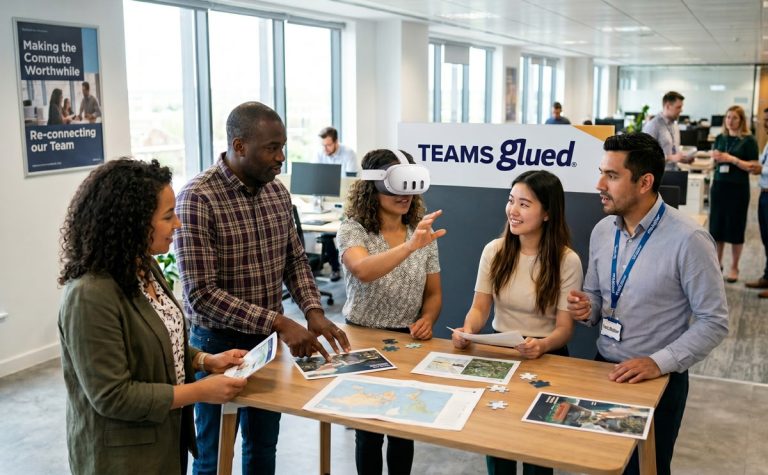
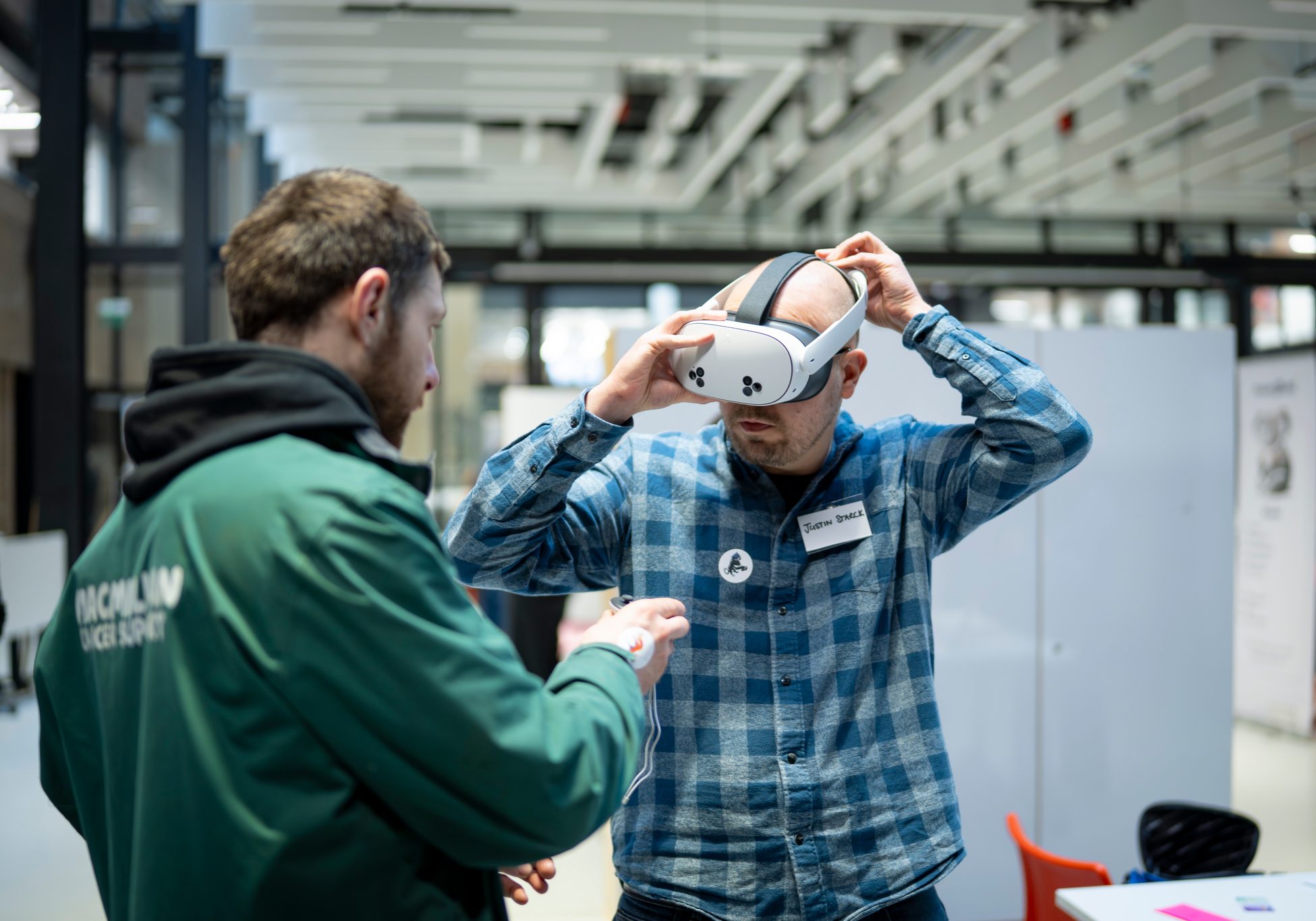
Teams Glued comes into the office and runs group experiences using VR, team resources and facilitation. People work in pods, usually with a headset in play, and others contribute through the resources around them. The point is not the technology by itself. The point is what the shared challenge reveals.
Under a bit of pressure, teams show how they really communicate. Who takes charge? Who listens? Who spots patterns? Who holds back? Who helps the group slow down and think? Who brings energy when the team gets stuck?
Those observations are useful because they are not theoretical. They happen in the room.
That makes the debrief much more grounded. The conversation can move from “we should communicate better” to “we saw what happened when we rushed the decision” or “we made progress when we gave everyone space to contribute”.
For HR teams, that matters. Many organisations already spend money on learning, development, engagement activities, and team days. The harder part is making those experiences stick.
Teams Glued gives people a shared reference point. It creates a story the team can use afterwards. It helps individuals see their own style, notice others’ strengths, and understand how behaviour affects performance.
Used well, this is not a one-off treat. It becomes part of the organisation’s culture infrastructure: a practical way to make office days more purposeful, more inclusive and more useful.
What an office anchor day could look like
An anchor day should not feel like a normal office day with a team activity bolted on.
It should have a clear beginning, a reason for being together and a useful endpoint.
Before the day, tell people why they are being invited in. Something as simple as this works:
“We are using this office day to reconnect as a team, practise collaboration under pressure and agree on a few small habits that will make hybrid working easier.”
That is a very different message from “everyone needs to be in on Thursday”.
During the day, give people a shared challenge. This is where an immersive, pod-based format works well because it gives people something immediate to do together. They are not being asked to make small talk. They are solving something.
After the challenge, spend time on the debrief. The result matters less than the behaviour. How did people communicate? Where did assumptions creep in? Who had useful information that the group nearly missed? What changed when the team slowed down or listened differently?
Then end with commitments. Not ten. Just two or three. For example, how the team will include new joiners more deliberately, how hybrid meetings will be run, or how office days will be used in future.
The day should leave people with something practical to carry back into work.
Keeping hybrid and remote workers included
One risk of an office-led culture is that it can inadvertently create an inner circle.
That is why the design matters.
Cohorts can be rotated so the same people are not always in the room. The format can be repeated across teams, offices or regions so people have a comparable experience even if they attend on different days. Managers can then pick up the same questions in team meetings and one-to-ones afterwards.
The follow-up is where much of the value lies.
A manager might ask, “What did we learn about how we communicate?” or “What made the biggest difference when we were under pressure?” or “What do we want to change about how we use office time?”
Those are simple questions, but they turn a shared experience into a working habit.
It is also worth keeping these moments inside the working day, where possible. That makes participation easier for carers, commuters, non-drinkers, people with evening commitments and those who simply do not want work to take over more of their personal life.
Inclusive culture is not just about who gets invited. It is about who can realistically take part.
Anchor Day agenda template
90-minute version
Use this when the aim is a focused team reset.
Start with ten minutes of context. Explain why people are together and what the session is meant to help with. Keep it plain: reconnecting, practising collaboration and making hybrid work a little easier.
Spend the next ten minutes setting up the behavioural lens. Ask people to think about how they tend to behave under pressure. Do they jump in quickly? Step back and observe? Look for structure? Keep morale up?
Then move into the immersive challenge for around 35 minutes. Small groups work in pods, using the VR element, supporting resources and facilitation. The important thing is that everyone has a way to contribute.
Use the next 20 minutes for the debrief. Focus on what happened in the team, not just whether the task was completed.
Close with 15 minutes on commitments. Agree on two or three things the team wants to do differently, and decide how the manager will follow up.
Half-day version
Use this when the aim is deeper team development.
Begin with a brief welcome and a clear explanation of the day’s purpose. This is not a break from work; it is work on how the team works.
Then spend around 30 minutes exploring working styles. Keep it practical. How do different people respond to pressure, ambiguity, pace and decision-making?
The immersive challenge can then run for around an hour. This gives the team enough time to get absorbed in the task and for real patterns to emerge.
After a short break, spend 45 minutes on the debrief. This is where the value is often created. Look at the moments where the team moved quickly, got stuck, adapted or missed something important.
Use the final 30 minutes to connect the experience back to hybrid working. What should office days be for? How will the team include people who are not always physically present? What needs to change in meetings, onboarding or project work?
Finish by capturing feedback and agreeing on the next follow-up conversation.
Internal comms script HR can use
Subject: Making our next office day worth the commute
Hi everyone,
Our next office day is designed to help us reconnect as a team and make our time together more useful.
Rather than bringing people in for a typical day of meetings, we will use a structured team challenge to examine how we collaborate, communicate, and support each other in a hybrid working environment.
The session will be practical, daytime and inclusive. It is not an after-work social, and it is not centred on alcohol. The aim is to give everyone a role, a shared challenge and time to reflect on what we learn.
During the session, we will take part in a facilitated team activity, examine how different working styles show up under pressure, and agree on a few simple commitments to make hybrid working better for the team.
The idea is straightforward: if we are asking people to come together in person, the day should have a clear purpose and create value that is hard to get from a normal video call.
More details will follow, but please hold the time in your diary.
Thank you,
[Name]
Final thought
Return-to-office is often treated as a policy question.
It is also a design question.
People are more likely to value office days when those days help them build relationships, solve real problems, understand each other and leave with something useful.
The commute is a higher bar than it used to be. That is not a bad thing. It is useful feedback.
The organisations that handle this well will be the ones that stop treating presence as proof of culture and start making the office feel genuinely worth attending.