
Conflict competence: turning friction into performance
Most organisations do not lose time to dramatic disputes within teams alone. It happens in the quieter forms of conflict that rarely make it into a formal case: the meeting after the meeting, the email written to prove a point, the colleague who stops raising concerns, the manager who delays a difficult conversation until the issue hardens.
That is why HR’s opportunity is larger than handling grievances well. It is to help build the organisational capability to disagree well before everyday friction turns into formal conflict.
The scale of the issue is hard to ignore. The Chartered Institute of Personnel and Development (CIPD), drawing on Acas-commissioned research, estimates that workplace conflict costs UK organisations £28.5 billion a year, or more than £1,000 per employee (CIPD Workplace Mediation factsheet). More recent CIPD reporting also suggests a meaningful gap between confidence in formal procedures and employees’ lived experience of resolution. In other words, the organisational cost is not only in the conflicts we can see. It is also in the everyday friction that slows teams down long before anyone files a complaint.
The hidden cost of low-grade conflict
Low-grade conflict does not always look dramatic. It often looks operational.
It shows up as avoidance instead of a challenge. Sarcasm instead of clarity. Rework instead of alignment. Silence instead of informed dissent. A team can look polite, busy and outwardly functional while quietly becoming slower, less creative and more defensive.
For HR leaders, this matters because low-grade conflict is rarely just a relationship issue. It is a performance issue.
When people stop saying what they think, decision quality tends to fall. When tension is expressed indirectly, managers spend more time interpreting behaviour and less time addressing work. When a team loses confidence in how to handle disagreement, ambiguity expands, trust thins out, and avoidable escalations become more likely.
Seen this way, conflict is not always a sign of bad people or a broken culture. Very often, it is the predictable result of people operating under pressure: unclear roles, competing priorities, identity threats, time pressure, perceived status differences, or simple uncertainty about how to speak candidly without causing damage.
That is a more constructive frame. If conflict is often pattern-based, then capability can be built.
“Disagree well” is a human skill, not just a workshop topic
Many organisations still approach conflict from the back end. They train managers on policy, process and escalation routes. Those things matter. They create fairness, consistency and legal discipline.
But policy knowledge on its own does not give people the behavioural fluency to handle friction in the moment.
A manager can understand the grievance process perfectly and still avoid a difficult conversation for three months. A team can complete a communication workshop and still default to defensiveness under time pressure. Insight is useful, but it is not rehearsal.
Conflict competence sits in that gap.
It is the practical ability to stay in the conversation when the stakes rise. To notice what is happening in the room. To adjust tone without losing honesty. To challenge without humiliating. To repair when something lands badly. And to do all of that while work still needs to move.
That is why teams need more than instruction. They need environments where they can practise conflict behaviours safely, under enough pressure for habits to appear, but without real-world consequences.
The four micro-skills of conflict competence
For most teams, conflict competence does not begin with a grand framework. It begins with a handful of repeatable micro-skills.
1) Clarify intent
When tension rises, people often infer motive too quickly.
“She is blocking this.” “He is trying to control the discussion.” “They do not respect the function.”
A more skilled move is to clarify intent before reacting to impact. That does not mean excusing poor behaviour. It means creating enough space to distinguish between bad intent and bad execution.
Useful prompts include:
- “Can I check what outcome you are aiming for here?”
- “What concern are you most focused on?”
- “I may be interpreting this too narrowly. What are you trying to protect?”
2) Name the tension
Teams often suffer not because tension exists, but because nobody names it.
The conversation drifts sideways. People become less direct. Side channels emerge. The issue becomes harder to address precisely because everyone is trying not to make it worse.
Naming the tension early can lower the temperature.
- “I think we are balancing speed against quality here.”
- “It feels as though there is some frustration in the room. Can we slow down to make that debatable?”
- “We may be solving two different problems without realising it.”
3) Ask better questions
Under pressure, questions often become disguised positions.
“Why would we do that?” can sound like dismissal. “Have you even thought about the risk?” can sound like an accusation.
Better questions widen the conversation rather than close it.
- “What are we not seeing yet?”
- “Where do you think my view is incomplete?”
- “What would make this workable from your side?”
- “What would success need from both of us?”
4) Choose a behaviour, not just a viewpoint
This may be the most important shift.
People often assume that conflict competence is about saying the right thing. In practice, it is often about choosing the right behaviour for the moment: slowing down, inviting a quieter voice in, being more explicit, summarising agreement, pausing before rebutting, or acknowledging impact before defending intent.
High-performing teams do not remove friction. They become better at selecting behaviours that help the team move through it.
What does practice look like in the real world?
One reason conflict capability remains underdeveloped is that most teams do not get to rehearse it. They either discuss conflict in theory or deal with it only when it becomes real, political and expensive.
This is where experiential formats can become useful.
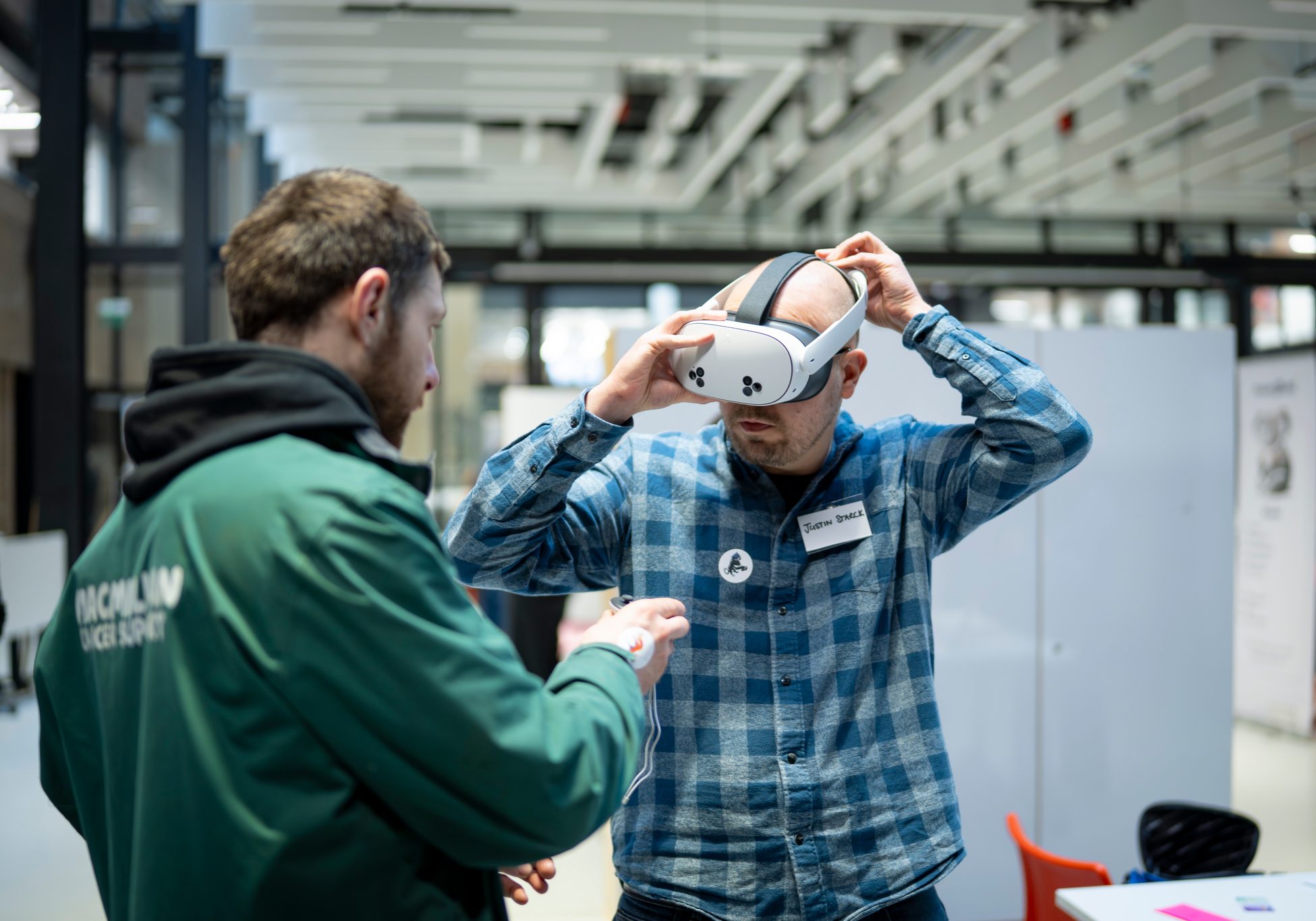
Teams Glued offers an interesting example of this principle without needing to be positioned as a formal conflict intervention. Its format combines behavioural preferences, defined team roles, a timed VR puzzle and facilitated reflection. The pressure is real enough to expose habits, but the consequences are contained. People can experiment with a different response and see the impact quickly.
A typical scenario is simple on the surface. One person is in the headset, navigating the virtual challenge. Others are outside it, interpreting clues, coordinating information and trying to keep the team aligned while the clock runs down.
What emerges is often highly familiar to any HR leader:
- Under pressure, one person dominates and mistakes speed for leadership.
- One person withdraws because there is no clear opening to contribute.
- Signals get missed because the team is solving in parallel instead of together.
- Frustration gets expressed as brevity, certainty or over-direction.
- Repair only occurs when someone pauses and changes how they communicate.
That is the learning value. Not the puzzle itself, but the visibility of escalation, silence, domination and repair as they happen.
When followed by skilled reflection, teams can move from personality labels to behaviour choices:
What did I default to?
What did the team need from me instead?
What happened when I changed my approach?
What will I do differently back at work?
That is much closer to building capability than simply reminding managers what the policy says.
What HR can actually measure?
If conflict competence is treated seriously, it should be observable.
Not every measure needs to be perfect, but HR can track whether teams are becoming more adept at dealing with friction constructively before it becomes formal.
A practical starting set might include:
- Psychological safety pulse: Do people feel able to raise concerns, admit mistakes and challenge ideas respectfully?
- Collaboration friction pulse: Where are teams experiencing avoidable rework, avoidance or communication breakdown?
- Manager confidence: Do line managers feel more able to address tension early and hold candid conversations?
- Resolution patterns: Are fewer issues moving straight to formal routes because earlier conversations are happening better?
- Qualitative signals: Are employees describing more direct, respectful challenges and fewer unresolved undercurrents?
The aim is not to create a perfect index. It is to shift conflict from a reactive employee-relations topic into an early, measurable team capability.
The strategic opportunity for HR
Conflict will never disappear from organisational life, nor should it. In complex organisations, disagreement is often a sign that important differences are being surfaced.
The real question is whether teams have the skill to work productively with friction.
HR leaders have an opportunity to move the conversation beyond prevention in the narrow sense. Not by ignoring policy, mediation or formal process, but by complementing them with capability-building: helping managers and teams recognise patterns under pressure, practise better responses, and repair faster.
This is also where Teams Glued can play a practical role. Rather than asking people to talk abstractly about communication, it gives teams a shared experience of pressure, ambiguity and interdependence. Through the combination of timed challenge, defined team roles and facilitated reflection, HR can create a safe-to-fail environment where unhelpful conflict patterns become visible early and can be discussed constructively.
That matters because many of the behaviours that sit underneath conflict escalation are hard to spot in a standard workshop. Silence can look like agreement. Dominance can look like decisiveness. Withdrawal can look calm. In an immersive team exercise, those habits are easier to see, name and work on together.
Used well, this gives HR a credible bridge between formal policy and everyday team practice. It can help managers and teams build the confidence to have earlier conversations, adapt their communication style under pressure and strengthen the behavioural conditions that support psychological safety and performance.
That is what conflict competence looks like.
Not the absence of tension. The presence of skill.
One-page checklist: conflict competence for managers
Use this as a quick self-check before, during and after a difficult team interaction.
Before the conversation
- Have I defined the issue clearly, or am I reacting to my interpretation of it?
- Do I know what outcome matters most here: clarity, repair, decision, accountability, or escalation?
- What pressure might the other person be under that I need to factor in?
- What behaviour will help most: directness, curiosity, calm, structure, or challenge?
- Am I preparing to understand as well as to respond?
During the conversation
- Have I clarified intent before assuming motive?
- Have I named the real tension rather than circling around it?
- Am I asking questions that open the issue up rather than shut it down?
- Have I made room for quieter voices or alternative interpretations?
- Am I staying specific about behaviour and impact, rather than making it personal?
- If the temperature is rising, have I slowed the pace rather than increased force?
After the conversation
- Was the issue genuinely addressed, or merely parked?
- What behaviour of mine helped the conversation move forward?
- What behaviour of mine may have narrowed it?
- Is there a repair needed with any individual or with the wider team?
- What follow-up is needed so the issue does not return in a different form?
Team warning signs to watch
- People comply in the meeting and challenge afterwards.
- Decisions keep getting reopened because the disagreement was never properly surfaced.
- Humour becomes edged or sarcastic.
- One or two people dominate all pressured discussions.
- Silence gets mistaken for alignment.
- The same friction keeps reappearing with different content.
N.B.: when mediation is needed vs when skill-building may be enough
This is a practical guide, not legal advice. Formal HR, employee relations or legal input may be needed depending on the facts.
Skill-building may be enough when:
- The issue is primarily about communication habits, role ambiguity, working styles or avoidable misunderstanding
- Trust is strained but still recoverable
- Both parties are willing to engage directly
- The goal is to improve how the team handles tension going forward
- No serious misconduct or protected-characteristic issue is alleged
Mediation may be the better route when:
- The relationship has become stuck, and direct conversations are no longer working
- There is ongoing tension affecting performance or well-being
- Both parties need structured support from an impartial third party
- There is value in preserving the working relationship, but confidence has broken down
Formal process is more likely to be needed when:
- There are allegations of serious misconduct
- There may be discrimination, harassment, retaliation or other legal risk
- One or both parties do not feel safe engaging informally
- Facts need formal investigation, evidence review or procedural action
The judgment HR often needs to make is not “training or mediation or policy,” but which route best fits the issue at its current stage.
Book a demo
Could your team benefit from Teams Glued?
